People Don't Resist Change. They Resist Being Surprised by It.
People can handle change. What they struggle with is late news, secondhand news, or leaders who seem to know more than they say.

When a team pushes back on a new direction, the easy read is that they're stuck in their ways. In my experience, that read is usually wrong. People can handle change. What they struggle with is late news, secondhand news, or leaders who seem to know more than they say.
The numbers back this up. Gartner surveyed more than 2,850 employees in April 2025, and 79% reported low trust in their organization's ability to change. In a separate survey, only 32% of mid-to-senior leaders reported healthy adoption of the last change they led. That tells me trust, and how we handle it, sits at the center of the problem.
The Leader Goes First
In Patrick Lencioni's The Five Dysfunctions of a Team, trust is the foundation. He calls it vulnerability-based trust: people admit what they don't know, where they made a mistake, or when they need help.
That kind of trust starts with the leader. I say what I know instead of acting as if I have every answer. If I perform certainty from the front of the room, the team learns that uncertainty isn't safe, and the real questions go underground. Underground questions keep travelling. They attach to rumours and grow harder to address than the original change.
What Keeps Trust During Deep Change
I rely on a simple structure:
- Say what's decided, what isn't, and when you'll come back with an answer.
- Explain the why before the what. The why gives people context even when the what is still forming.
- Name what isn't changing. It gives people solid ground to stand on while everything else moves.
- Keep small promises. If I say I'll come back to you Friday, I come back Friday, even without the full answer.
- Show up in person and stay for the uncomfortable questions.
- Let the people closest to the work help shape the change. They go from people the change happens to, to people who help make it work.
That Friday promise matters more than it looks. The commitment is to show up, with or without new information. When I arrive on time with nothing new to report, the act itself tells the team I keep my word.
When You Find Out Late Yourself
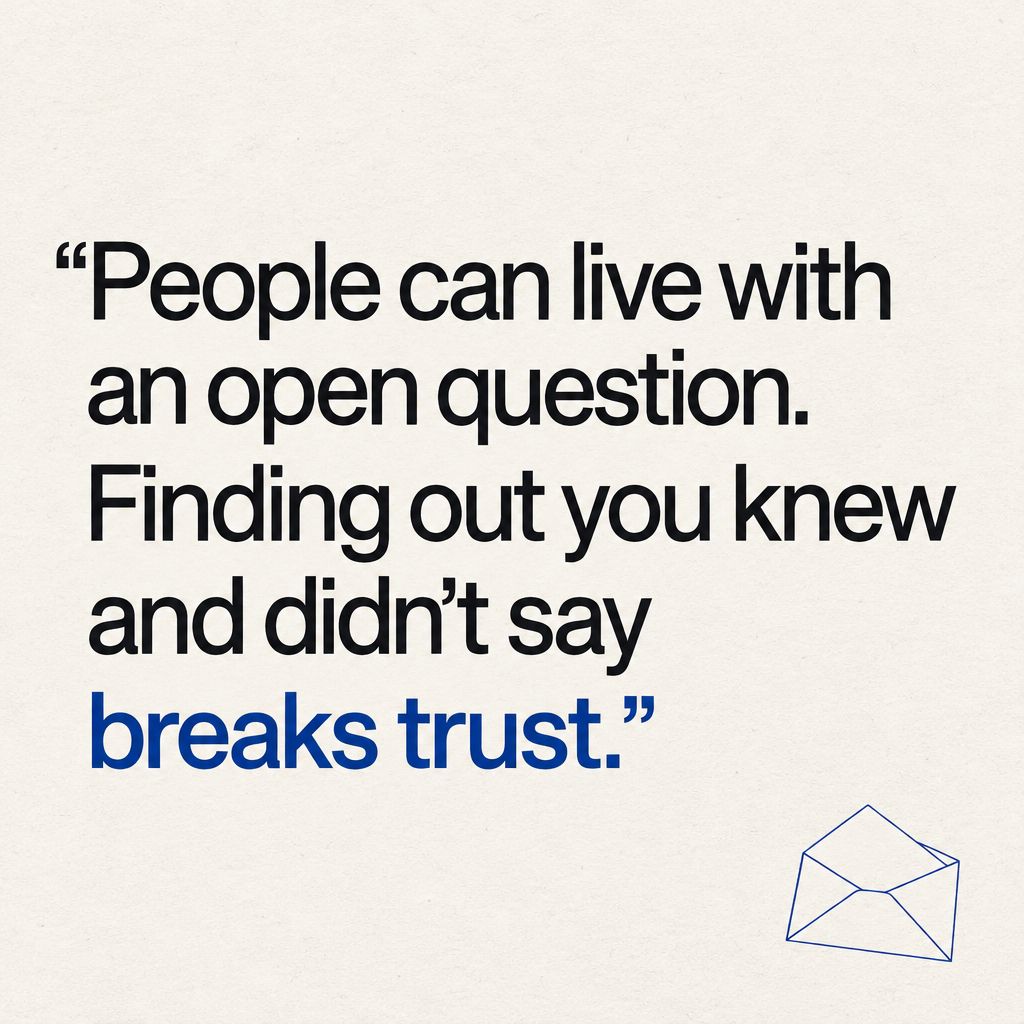
Sometimes I learn about a change late too. Even then, I can say what I know, what I don't, and when I'll return with an answer. People can live with an open question. Finding out I knew and didn't say breaks something that's hard to rebuild.
Trust Them With the Truth
Underneath the structure sits a belief. I have to trust my people with uncertainty before I can speak into it. They deserve early, direct, honest news, and they can handle it. When you bring them in early and let them shape the work, you turn a moment of potential resistance into a stronger, more resilient team.