Put the standard in before the tool.
Without a written standard, a tool has nothing clear to enforce.

In short: Write down what a good decision looks like before you set up a tool. A tool can hold a standard and speed it up. It can't create one. If there's no standard, the tool just makes the mess faster.
- A complete decision record has three parts: the call, the owner, and the date.
- Alignment is how the room feels. A decision record is what you write down, and that's what people can act on.
- Keep all three parts together, because any one of them alone leaves the decision open.
- Define the standard first. Then pick a tool and set it up to enforce that standard.
I put the standard in before the tool. The order matters. If your team walks out of a meeting nodding and then does three different things, this is probably where it went wrong. And it's fixable before you buy anything.
Why does the standard have to come first?
A tool doesn't create the standard. The standard has to exist first. It says what good looks like in writing before you ask any tool to capture, organize, or speed up the work.
I like tools fine. I just want the decision made in the right order. First you define the standard. Then you choose the tool.
Without a written standard, a tool has nothing clear to enforce. Sure, it'll collect notes, move tasks around, and show plenty of activity. It can't decide what a complete decision looks like. That part's on the team, and it comes first.
Where this lands: A tool can only enforce a standard you've already written. So write it first.
What does a good decision record look like?
The standard for a decision is pretty simple. A decision is a record.
Each record is one set of three things:
- The call. What was decided.
- The owner. Who's responsible for the action.
- The date. When the action is due or gets reviewed.
Your team might call these action items, owners, and due dates. Fine. Use whatever labels you already use. What counts is having the complete set written down.
How is alignment different from a decision record?
Alignment is a feeling. People can walk out aligned on a direction and still picture a different call, a different owner, a different date. The feeling doesn't create a decision on its own. The decision exists once the call, the owner, and the date are written down together.
That difference is the standard. It gives the team something clear to produce, and something clear to check afterward.
Short version: A decision counts once the call, the owner, and the date are on the page together. Until then, it's a good feeling about a direction.
Why should the tool come second?
A tool is handy for holding the record. It'll surface the record, make it easier to find, and help the team work from the same written set.
Useful jobs, sure. They're still second-order jobs.
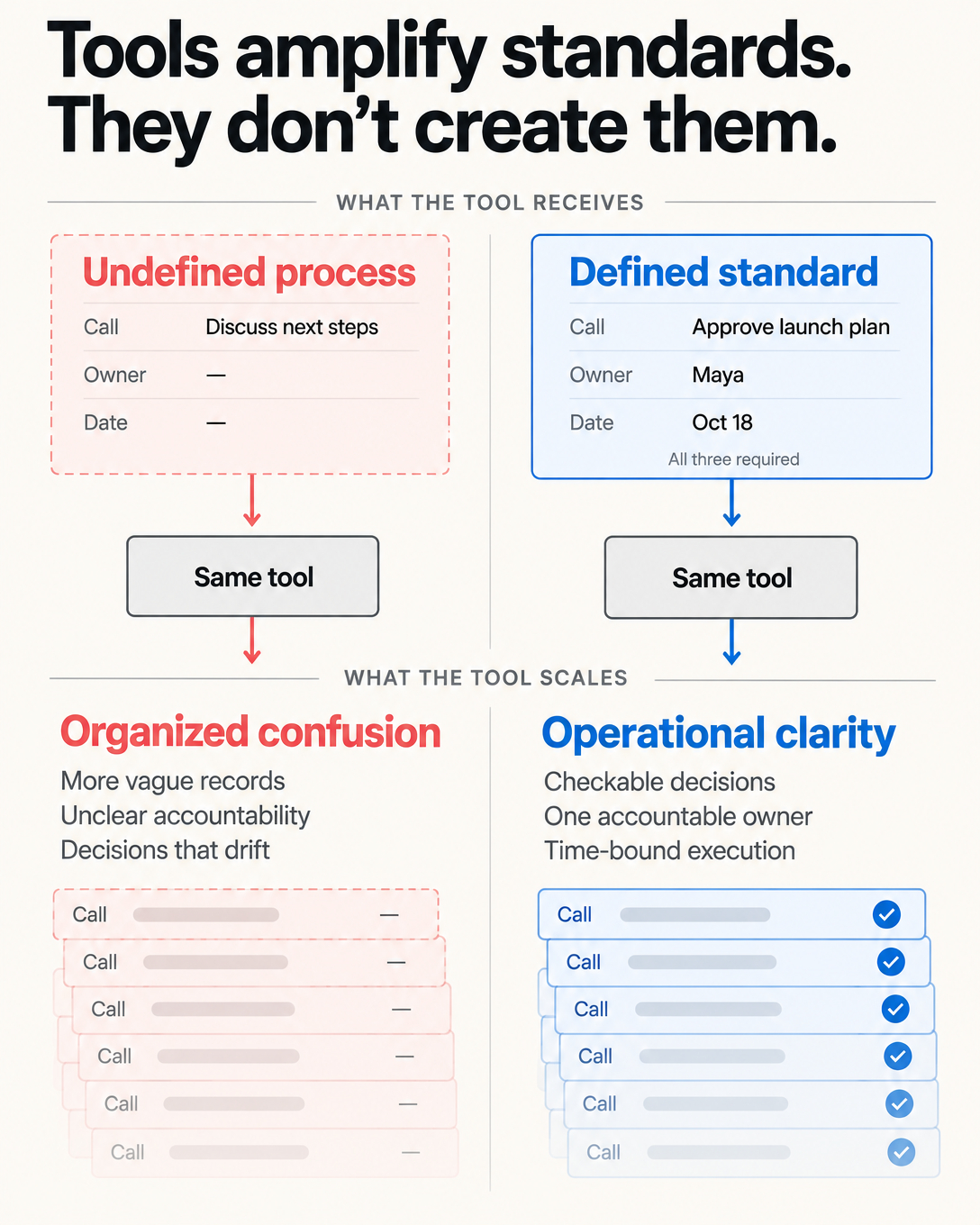
The tool can't supply a missing standard. If the team hasn't defined what good looks like, the tool gets incomplete instructions. It saves whatever gets typed in. It might make that info easier to move around. Moving stuff around faster doesn't make it any clearer, though.
If the standard is missing, the tool just makes the mess faster.
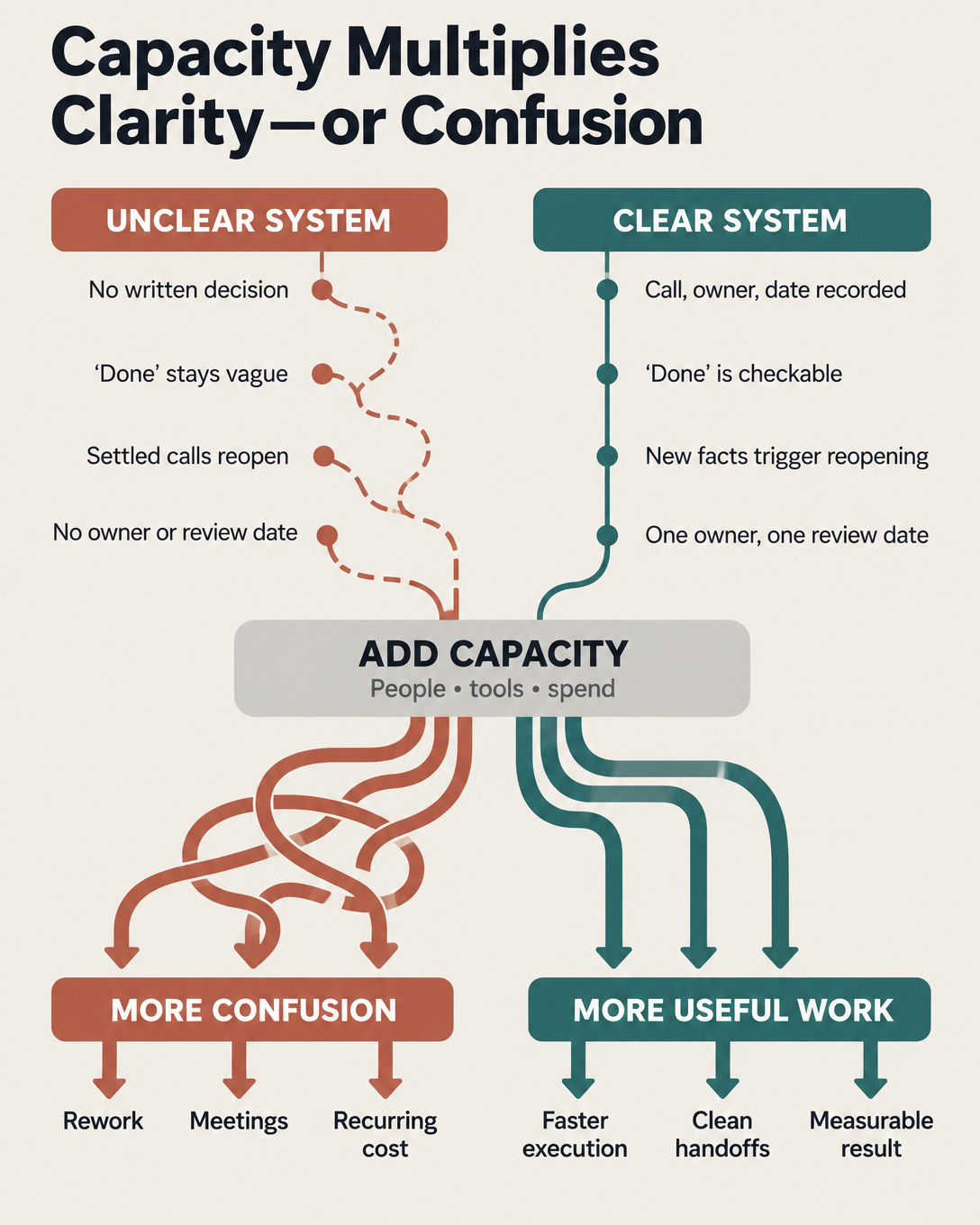
That's the risk. Activity starts to look like progress when the record underneath is incomplete. A clean interface will happily display a vague decision, and a fast workflow will move an unclear action from one place to another and back again, and the system can be working exactly as configured the whole time while the decision itself stays unclear.
The written standard comes before the workflow.
Bottom line here: A tool holds and moves whatever you give it. So a vague standard in means vague records out, just faster.
Why keep the call, the owner, and the date together?
A call with no owner is incomplete. So is an owner with no date. And a date with no call attached is incomplete too.
Ranking which of the three matters most won't get you far. Keep them together. The written set is the standard.
This is where alignment actually earns its keep. It's the moment the team can write the record down. State the call, name the owner, set the date. Now the direction has a form someone can check later.
Without that form, the feeling stays in the room after the meeting ends. Once it's written, people can act on the decision somewhere else.
The one to remember: Any one of the three on its own leaves the decision open. Write all three down in the same place.
How do you put the standard in first?
The practical steps are short.
- Write down what good looks like.
- Define a complete decision as the call, the owner, and the date. Use action items, owners, and due dates if that's what your team says.
- Keep the three together.
Then choose the tool.
Set up the tool around the standard. Use it to hold the record and make the record visible. Don't ask the tool to invent the standard, or to turn an undefined process into a defined one.
The tool's job is to support the standard.
This order also keeps the conversation honest. If the written set isn't complete, you see it before more automation piles on top. So the next step is obvious: finish the standard, then use the tool to support it.
The standard is what good looks like, written down. The tool is what helps the team work from it.
What this means for you: You could write this standard before your next meeting. It's three fields. The tool decision can wait until the standard exists.
What if your team needs to move fast?
The order matters most when the pressure to move fast is highest. Speed helps once the standard is clear. Before that, speed just shortens the distance between an undefined standard and a bigger pile of incomplete records.
Start with the written question: what does good look like? Write the answer in the same place the decision will live. Keep the call, the owner, and the date together. That's the record the team can use.
This keeps the tool in its proper role: supporting an existing standard. The team decides what good looks like. The tool can make the record visible and easier to work from, but someone still has to define the record before the tool can help.
The discipline is simple. Define the standard, write it down, and bring in the tool after that. Flip the order, and you're back to a mess, but faster. In the right order, the tool finally has a clear job.
Under pressure: Speed only pays off once the standard is written down.
Put the standard in before the tool.
A tool doesn't create the standard, so the standard has to exist first. Skip it, and the tool just makes the mess faster.
Frequently asked questions
What is a decision record?
A written set of three things: the call (what was decided), the owner (who's responsible), and the date (when it's due or gets reviewed).
What's the difference between alignment and a decision record?
Alignment is a shared feeling about a direction. A decision record is written down. People can feel aligned and still leave with different ideas of the call, the owner, and the date.
Can a tool create the standard for my team?
No. A tool can hold, surface, and organize records. It can't decide what a complete decision looks like, so the team has to write that down first.
What happens if we adopt a tool without a standard?
The tool automates whatever is already there. As a result, incomplete records move faster, and activity can look like progress while decisions stay unclear.
Do we have to use the words call, owner, and date?
No. Action items, owners, and due dates work too. The complete set, written together, is what matters.
When should we pick the tool?
After the standard is written. Then set up the tool around the standard so it holds the record and makes it visible.
Doesn't writing the standard first slow us down?
The order matters most when the pressure to move fast is highest. Speed helps once the standard is clear. Before that, it just produces more incomplete records, faster.
What to take from this
- A tool can't create a standard. Write the standard first.
- A complete decision record has three parts: the call, the owner, and the date.
- Alignment is a feeling. The written record is what people can act on and check.
- Keep the three parts together, because any one alone leaves the decision open.
- Without a standard, a tool just makes the mess faster.