
A decision that is not written down is not a decision.
I stopped blaming the people in the room a long time ago. The people are fine. The process is missing one step. Write the decision down in full before anyone leaves.

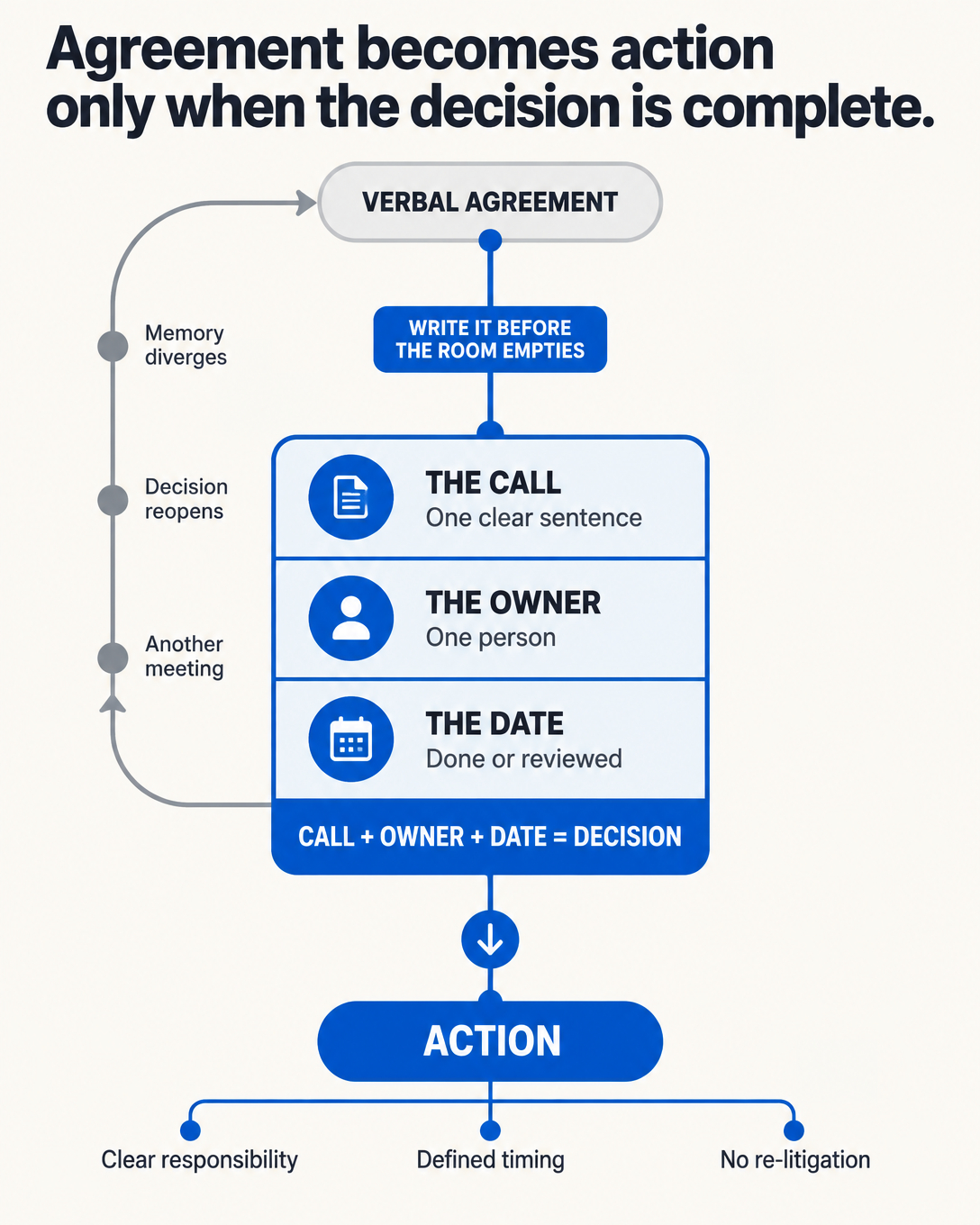
TL;DR: Alignment in a meeting is a feeling. A decision is a written record of three things: the call, the owner, and the date. All three, together, before the room empties. Missing any one of them means the decision does not exist, and the team will reconvene to re-litigate it.
- A real decision requires three elements written down together: the call, the owner, and the date.
- Alignment at the end of a meeting is a feeling. A decision is a record.
- The owner is the element that disappears most often, because naming someone feels uncomfortable after a room has relaxed.
- Every unwritten decision schedules a future meeting you do not know about yet.
- The window to capture the decision is inside the meeting. Once the room empties, the window closes.
I hold a simple standard for meetings. A meeting that ended with alignment and a meeting that produced a decision are two different outcomes. Alignment is a feeling. A decision is a record.
The feeling is pleasant. Everyone nods, agrees on the direction, leaves the room believing it's handled.
Then nothing happens.
I stopped blaming the people in the room a long time ago. The people are fine. The process is missing one step. Write the decision down, in full, before anyone leaves.
What Is a Real Decision?
A decision is a written set of three things, all together:
- The call. What was decided, in one plain sentence.
- The owner. One name. One person.
- The date. When it will be done or reviewed.
All three, written down, before the room empties. If any one is missing, the decision does not exist. It feels like it exists. People will reference it later as if it exists. It does not.
Two out of three gets you the same result as zero. A call with a date and no owner sits still. A call with an owner and no date drifts. An owner with a date and no clear call executes the wrong thing. The set only works as a set.
The written set is the only output that matters. Everything before it is just input.
Which Element Goes Missing Most Often?
The owner. Almost always.
The room debates the call. The room negotiates the date. Then everyone relaxes, and nobody puts a name on it. This is easy to miss because the other two elements felt like the hard part.
Without a name, the decision belongs to everyone. Which means it belongs to no one.
Naming someone as owner feels sharp in the room. It makes accountability visible in front of peers. So the room lets it slide, absorbs the responsibility collectively, and everyone feels okay about it.
That collective comfort is the most expensive outcome. Ten seconds and a name written next to the call is the fix. The person named gets a chance to object, adjust, or accept. Then it's real.
The owner is the element that converts a call into movement. Without it, the other two are just notes.
What Does a Missing Decision Actually Cost?
The missed deadline is the visible cost. The deeper cost is re-litigation.
Weeks later, the team reconvenes. The conversation gets re-opened. The context gets re-established. The positions get re-argued. Energy already spent gets spent again.
And the people in that second room are often not the same people who were in the first one. They reach a slightly different conclusion. Now there are two versions of the same decision, and neither one is written down either.
Run this across an organization over months, and the real damage becomes clear: the calendar fills with conversations that already happened. The same questions cycle back. The team moves, but it does not go anywhere.
Every unwritten decision is a future meeting that is already scheduled without anyone knowing it.
The re-litigation cost is not just time. It is the accumulated drag of having the same argument twice, with different people, reaching a slightly different answer.
When Does the Window Close?
The window to make a decision real sits inside the meeting, before the room empties.
A follow-up email arrives too late. A Tuesday recap arrives too late. By then, the feeling of alignment is already doing its work. People walked out believing the matter was handled. Memories of the call have started to diverge. The person you would have named as owner has moved on to the next thing.
Once the room empties, the window closes. You can still chase the decision afterward, and sometimes you catch it. Chasing costs more than capturing. Every hour between the agreement and the record weakens the record.
The last two minutes of a meeting are the most valuable two minutes in it.
Capturing a decision inside the meeting costs two minutes. Chasing it afterward costs weeks.
How to Fix It
No tool required. No template. No process rollout.
Write down the call, the owner, and the date. Together. In the meeting, before the room empties. Read it back. Give everyone five seconds to object. Silence means the record stands.
The effect shows up fast. Follow-up meetings shrink. Status questions get answered by pointing at a sentence. The person with their name on it starts moving before anyone has to ask.
There will be resistance. Visible accountability feels sharp the first few times. Hold the standard anyway. The sharpness fades. The clarity stays.
The fix is two minutes and a sentence. The cost of skipping it is measured in weeks.
Frequently Asked Questions
What makes a decision real in a meeting?
A decision is real when three things are written down together: the call, the owner, and the date. All three must be present. Missing any one of them means the decision does not exist in practice.
Why is the owner the most commonly missing element?
Because naming a single person as owner makes accountability visible in a group setting. After a room has relaxed and agreed, assigning a name feels uncomfortable. So it gets skipped, and responsibility defaults to everyone, which means no one acts on it.
What happens when a decision is not written down?
The team reconvenes later and re-litigates the issue. Context has to be rebuilt, positions re-argued, and energy already spent gets spent again. Often with different people reaching a slightly different conclusion.
When is the right time to write a decision down?
Inside the meeting, before the room empties. A follow-up email or recap comes too late. By then, alignment has already created a false sense that the matter is resolved.
Does this require a special tool or process?
No. A shared doc, a whiteboard, a notes app, anything works. The medium is irrelevant. What matters is that all three elements are written down together before the meeting ends.
What should you do if the owner pushes back on being named?
Let them. The push back is the conversation that should happen inside the meeting. The person named gets a chance to object, adjust scope, or accept. That negotiation in the room is far cheaper than discovering the mismatch two weeks later.
How do you handle a decision where ownership is genuinely shared?
Shared ownership is not a decision state, it is a holding pattern. Identify the single person accountable for the outcome, even if others contribute. One name. One accountability. The others are contributors, not owners.
What is the difference between alignment and a decision?
Alignment is a feeling that exists in the room during the meeting. A decision is a record that exists after the room empties. Alignment can disappear. A record can be pointed to.
Key Takeaways
- A decision requires three written elements: the call, the owner, and the date. All three, together, before the meeting ends.
- Alignment at the end of a meeting is a feeling. It is not a decision.
- The owner is the element that converts a call into action. It disappears most often because naming someone feels uncomfortable after a room has relaxed.
- Every unwritten decision schedules a future re-litigation meeting without anyone knowing it.
- The window to capture a decision is inside the meeting. Once the room empties, the window closes and chasing the decision costs more than capturing it did.
- Shared ownership is a holding pattern. One name, one accountability.
- The fix is two minutes. Write the call, the owner, and the date. Read it back. Silence means the record stands.
A decision that is not written down is not a decision.