
Why Ocado's Billion-Dollar Grocery Gamble Is Unraveling
Traditional grocery margins are 1–3% EBIT. If online grocery adds $10–$15 in delivery cost, that wipes out the entire margin stack. Automation that saves $4–$5 doesn't close the gap.

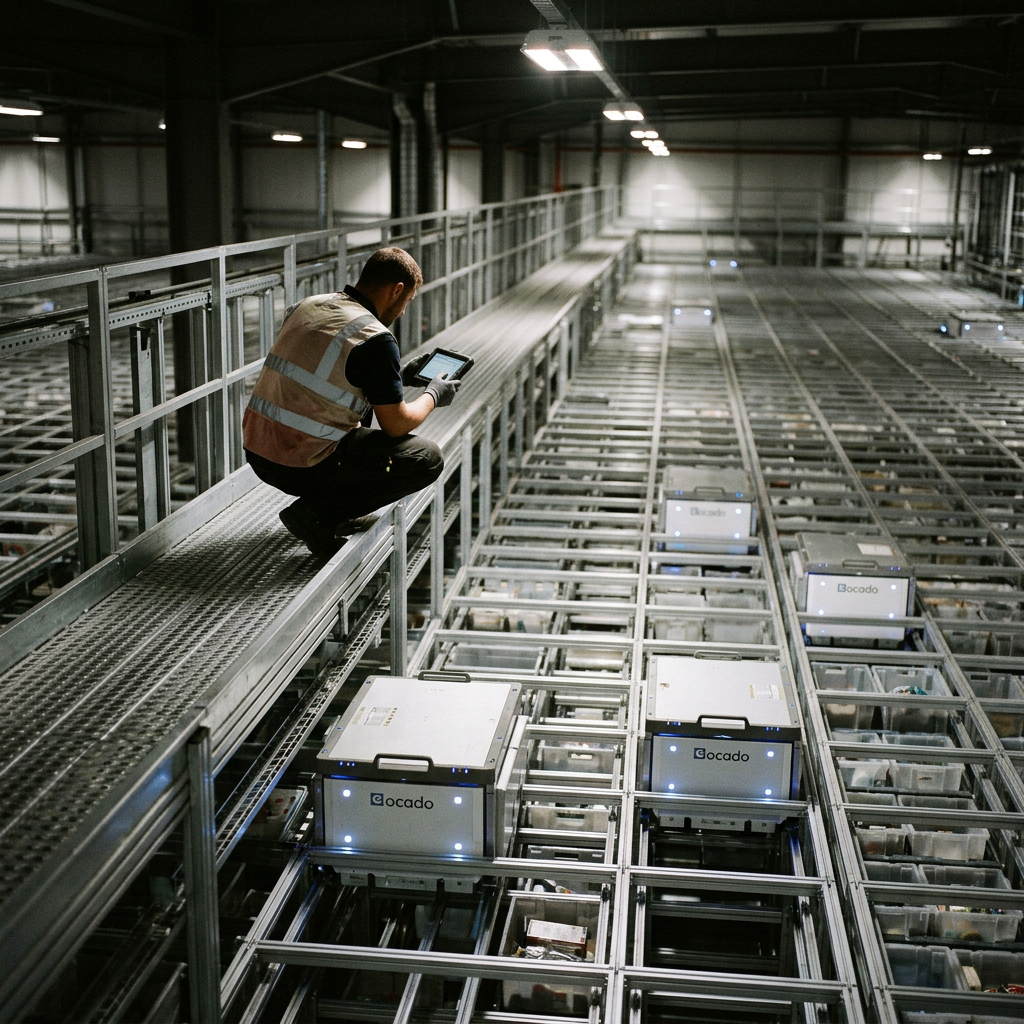
I wrote about Ocado's North American ambitions back in 2020. The promise was seductive: automated warehouses filled with robots, picking groceries faster than humans ever could, transforming online grocery from a messy store-based operation into an industrial logistics machine.
The reality looks different now.
Kroger is paying Ocado a one-time $350 million payout following warehouse closures and scrapped plans for additional facilities. Sobeys closed its Calgary automated warehouse due to slower-than-expected growth, while another planned for Vancouver remains on pause.
The technology works. The robots do what they're supposed to do. The software functions as designed.
But the economics tell a different story.
The Broken Promise
When Kroger announced they were stopping new Ocado warehouse construction, the moment revealed something fundamental about the assumptions behind the partnership.
The 2018 deal assumed rapid, sustained growth in online grocery demand. That growth spiked during COVID, reinforcing the narrative. But post-pandemic demand stabilized at a much lower penetration level than the models assumed.
The massive automated warehouses needed very high order density to amortize their cost. That demand simply didn't materialize in many markets.
The revealed assumption: Online grocery volume would be large enough to support a national network of highly automated fulfillment centers.
Kroger eventually realized something simpler. Stores are already close to customers. Stores can fulfill orders within hours. Centralized facilities add delivery distance and cost.
So Kroger shifted back toward store-based fulfillment and partnerships with delivery platforms like Instacart and DoorDash.
The Ocado model was designed around large, centralized robotic fulfillment centers. A purpose-built robotics warehouse network was supposed to outperform the existing store network.
In U.S. geography, that assumption proved weak.
The Geography Problem Nobody Wanted to Admit
Ocado's model worked in the U.K. because of high population density, short delivery distances, and concentrated urban markets.
The U.S. is the opposite: lower density, larger delivery radiuses, more suburban distribution.
Centralized automated grocery fulfillment struggles economically in sprawling markets. The technology can't change distance. Location can.
When Sobeys cited "market size" and "slower-than-expected e-commerce growth in Alberta," they avoided the harder question: Why do these highly automated, capital-intensive facilities require everything to go perfectly just to break even?
When growth underperforms—even slightly—the economics collapse.
Canada magnifies every constraint the Ocado model struggles with in the U.S.: lower population density, fewer large metro clusters, longer delivery radiuses, harsher weather logistics.
Automation Solved the Wrong Constraint
Most grocery executives believe the labor cost of picking is the main problem. The realization that this isn't true usually comes when you model the unit economics of an online grocery order end-to-end.
A typical U.S. online grocery order has these cost components:
Picking labor: $5–$10
Packaging: $1–$3
Delivery logistics: $8–$20
Last-mile routing inefficiency: $3–$10
Even if automation reduced picking to near zero, the total order economics might only improve $6–$8. But if delivery is costing $15+, that's where the margin disappears.
This is why many automated facilities still struggle to reach profitability.
Delivery cost is fundamentally a stops-per-hour problem. In dense urban areas, a driver might complete 6–8 orders per hour, bringing delivery cost per order to $5–$7. In suburban areas, that drops to 3–4 orders per hour, pushing delivery cost to $10–$15. In low density areas, 2 orders per hour means $20+ per delivery.
Robots don't change this equation. Demand density does.
Traditional grocery margins are 1–3% EBIT. If online grocery adds $10–$15 in delivery cost, that wipes out the entire margin stack. Automation that saves $4–$5 doesn't close the gap.
Only density or higher order values does.
What Walmart Understood That Ocado's Partners Didn't
While Ocado's partners struggled, Walmart's online grocery business grew. The company now captures 31.6% of the total online grocery market share, while Kroger sits at 8.6%.
Walmart's strategy started with geography rather than technology. Instead of trying to engineer the grocery system around automation, Walmart designed the system around existing demand density and physical proximity to customers.
Walmart operates roughly 4,700 U.S. stores, and about 90% of Americans live within 10 miles of one. Instead of building centralized robotics facilities, Walmart turned those stores into micro-fulfillment nodes.
Orders are picked close to the customer. Delivery radiuses are shorter. Drivers can complete more stops per hour. Inventory is already on-site.
This solves the density constraint immediately because Walmart stores already sit inside dense demand zones.
Ocado's model tried to create density by building warehouses. Walmart simply used the density it already had.
One of Walmart's biggest strategic moves was pushing curbside pickup first, not delivery. Pickup removes the most expensive part of the system: last-mile transportation.
When customers drive to the store, delivery cost disappears, order density becomes irrelevant, and store labor becomes the primary cost. That dramatically improves online grocery unit economics.
The Capital Expenditure Trap
CFCs required massive up-front investment, with facilities often exceeding 300,000 square feet equipped with thousands of robots on giant grids.
Kroger's decision to locate the Ocado centers outside of cities turned out to be a key flaw. You didn't have enough people ordering, and you had a fair amount of distance to drive to get the orders to them. These large centers were just not processing enough orders to pay for all that technology investment.
Typical estimates for a large automated facility run $130M–$200M in total capital. If the facility runs near capacity, that capital cost can amortize efficiently. But when throughput is lower than expected, the capital cost per order rises sharply.
CFCs are engineered to operate at extremely high volume—30,000 to 50,000 orders per week at 70–85% facility utilization. What appears to be happening in several U.S. facilities is lower order density, particularly outside peak seasons.
When utilization drops below 60%, the economics change dramatically because capital costs remain fixed, robotics depreciation continues, and staffing overhead remains.
Automation systems are incredibly efficient when full and surprisingly expensive when half-empty.
The Market Is Thriving Without Ocado
Monthly U.S. online grocery sales rose sharply in December, increasing 32% from a year earlier to a record $12.7 billion. Online grocery spending accounted for 19% of weekly grocery spending in December, the highest share since May 2020.
This proves the market is thriving. But Ocado's partners aren't capturing their share despite the rising tide.
Walmart's most affluent customer segment, which makes more than $200,000 in annual income, now makes up 8% of its average monthly active user base. That affluent monthly user base has increased five times faster over the past year than its overall average monthly active users.
Walmart's growing popularity with higher-income households comes at the expense of supermarkets, hard discounters, and Target, each posting a drop in online grocery sales with higher-income households.
The Ocado model has been highly successful for Ocado in the U.K., but U.S. consumers have shown they value speed of delivery. Companies like Instacart and DoorDash expanded rapidly in recent years, rolling out services like 30-minute delivery.
Acknowledging this reality, Kroger noted it's deepening partnerships with third-party delivery companies.
Why Kroger and Sobeys Chose Ocado Over Their Own Stores
The short answer: They didn't believe their stores were logistics infrastructure. They believed their stores were retail locations, and that belief shaped every strategic decision that followed.
When executives at chains like Kroger or Sobeys evaluated e-commerce, they compared themselves to companies like Amazon—not to Walmart. That mental model pushed them toward centralized automation instead of store-based logistics.
Walmart stores were unusually well suited to online grocery before e-commerce even existed. Very large footprints, massive backrooms, wide aisles, large parking lots, high SKU consistency across stores.
Many traditional grocery chains have stores that look different: smaller footprints, narrow aisles, limited staging space, high SKU variation across locations, less backroom storage.
Operational leaders looked at that reality and concluded their stores were not designed for fulfillment. So they assumed the solution had to be new infrastructure.
Early store-picking experiments in grocery were extremely inefficient. Common early numbers showed 40–60 items picked per hour, congestion in aisles, customer complaints, and substitution problems.
At those productivity levels, picking costs were high and store operations were disrupted. Automation vendors offered a seductive promise: Robotics will solve the labor problem.
Companies like Ocado Group were essentially selling predictable industrial productivity. That narrative resonated strongly with operators frustrated by messy in-store fulfillment.
But a quiet shift occurred across the industry. Store picking got dramatically better. Five years ago, store picking averaged 50–70 items per hour. Today in many well-run operations, that number is 90–120 items per hour.
That improvement narrowed the economic gap between store fulfillment and centralized automation. Automation is still more efficient per picker—but the relative advantage shrank.
The Credibility Crisis
Ocado CEO Tim Steiner said the company has taken a pragmatic approach to refining the network. This has meant addressing some key challenges from early network planning decisions, in particular where the market has not developed as anticipated.
The changes made in relationships with both Sobeys and Kroger represent a reset of North American business, while reopening a substantial market for Ocado's much evolved technology.
Shares in the U.K.-based robotics company have fallen dramatically and are now back to their level 15 years ago, when the company went public. Investors are pricing in the North American failure.
Ocado expects £18 million in compensation this year for the Calgary closure, which will reduce FY26 fee revenue by £7 million. Partner defections are now directly impacting Ocado's financial performance.
The embarrassment of another flagship North American customer following in the footsteps of Kroger and scaling back on their Ocado plans cannot be ignored. This isn't the freedom to grow that shaking off mutual exclusivity deals was supposed to deliver.
What the Operational Data Reveals
When you look closely at the operational data from the automated Customer Fulfillment Centers, the most interesting signals are not dramatic failures. The facilities generally work technically very well.
What the numbers quietly reveal is something subtler: The economics only work under very narrow operating conditions.
Centralized automated fulfillment benefits from large orders. Large baskets allow high picking efficiency, better packing density, and fewer delivery stops per order. However, U.S. e-commerce behavior often produces smaller, more frequent baskets.
Weekly stock-up orders might average $120–$150, but top-up orders often come in at $40–$70. Smaller baskets increase delivery cost per dollar of groceries, packing overhead, and order handling cost.
Automation can optimize picking speed, but it cannot change basket size.
The logistics model for a CFC assumes dense delivery clusters—10 to 12 stops per route, 5 to 7 orders per driver hour. But in sprawling U.S. metropolitan areas, real-world routes often look closer to 5 to 7 stops per route and 3 to 4 orders per driver hour.
That gap dramatically increases last-mile cost. And last-mile cost is the largest variable in the system.
Many grocery chains report that pickup accounts for the majority of digital orders. Pickup eliminates delivery costs entirely. But centralized automated facilities are optimized for delivery logistics, not pickup.
That mismatch reduces the strategic advantage of the CFC model.
The Strategic Lesson
What happened here is a classic strategic pattern. Two companies start with the same physical asset: thousands of grocery stores near customers.
One company sees retail locations. The other sees a distributed logistics network.
The companies that partnered with Ocado were trying to build a logistics network. Walmart realized they already had one.
This story is really about how organizations interpret their own assets. The most powerful competitive advantages are often mundane, legacy infrastructure, widely misunderstood internally.
Walmart didn't win because it built something new. It won because it reinterpreted something old.
The grocery chains that partnered with Ocado actually had the same geographic advantage as Walmart in many markets—but their internal mental models prevented them from using it.
That's one of the most expensive strategic misreads in modern retail.
Ocado was betting on a future where grocery is heavily automated, delivery is dominant, and centralized logistics wins. The U.S. grocery market evolved toward a hybrid model where stores remain central, pickup dominates, and delivery economics constrain everything.
That divergence is what exposed the flaw.
Ocado's model still works extremely well in dense markets like the U.K. The mistake wasn't the technology. It was assuming logistics architectures travel easily across geographies.
In grocery, geography is destiny.
Investors and operators reading this data are gradually reaching a conclusion: Automated grocery fulfillment centers may not be the universal architecture of online grocery. They may instead be a specialized tool that works extremely well in dense urban markets.
That's a very different strategic role than the one originally envisioned.
And that distinction—between universal infrastructure and situational infrastructure—is the question the market is slowly answering.