Headcount Is No Longer the Growth Proxy
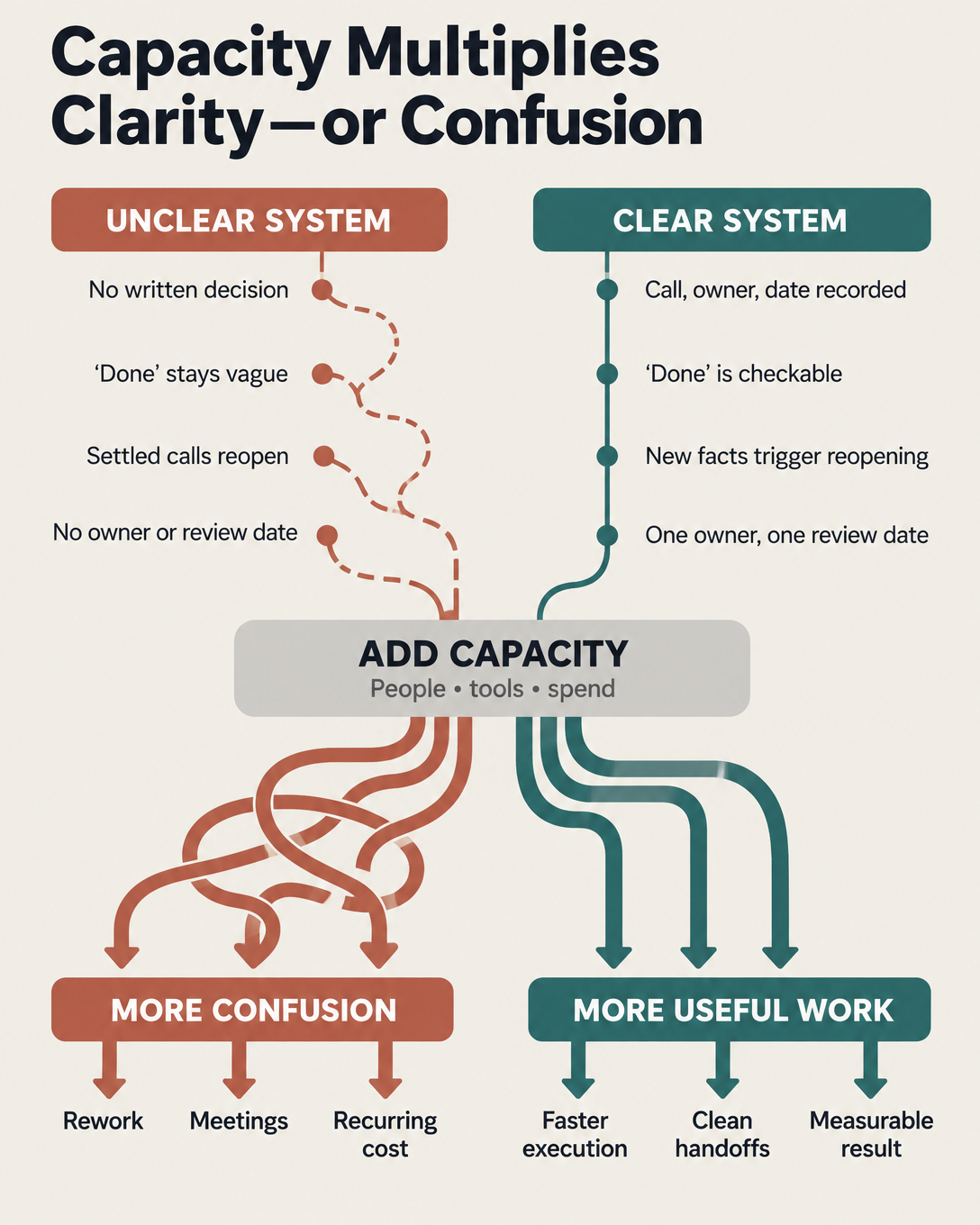
Every seat you add before mapping the value stream inherits the flaws of the old system.

Every acquisition arrives with an org chart. The chart travels with the deal, and it carries an unspoken instruction: rebuild this.
Across software businesses, I felt that instruction every time we closed. We inherited structures built for a different stage, and the pressure to recreate them was immediate. Add managers. Add specialists. Add seats.
The belief cracked slowly, through repeated post-acquisition decisions. Revenue could grow while headcount grew faster. Teams could be busy without being more effective. Busy is visible. Busy feels like momentum, and in a post-acquisition environment where the board wants proof the deal was right, visible momentum is seductive.
So I stopped treating headcount as evidence of progress. The question that matters is whether we're increasing useful output and enterprise value with discipline. AI made that distinction impossible to ignore, because it's decoupling revenue from headcount.
This article lays out how I redesigned the way we grow. You can apply it to your own business this quarter.
Start With the Value Stream, Not the Departments
When I sit down with a newly acquired software company, I ignore the department boundaries at first. I want to see how a prospect becomes a customer, how a customer gets value, and where cash and risk move through the business.
That means walking the funnel from lead to win, implementation and time to value, support and retention, product delivery, and the management decisions that connect them.
For each step, I ask four things:
- What is the intended outcome of this step?
- What is the current cycle time?
- Where are the handoffs?
- How much human capacity does it consume?
Then I compare the output we need with the capacity we already have. I hire when there is a clear bottleneck and a measurable return. I refuse to recreate the old org chart out of habit, because habit is exactly what makes the chart so durable. It is a template that travels with the deal.
That discipline protects the acquired team from needless churn. It also protects the capital from being converted into overhead.
💡 Redesign the work before you staff it. Every seat you add before mapping the value stream inherits the flaws of the old system.
The Six-Metric Scorecard
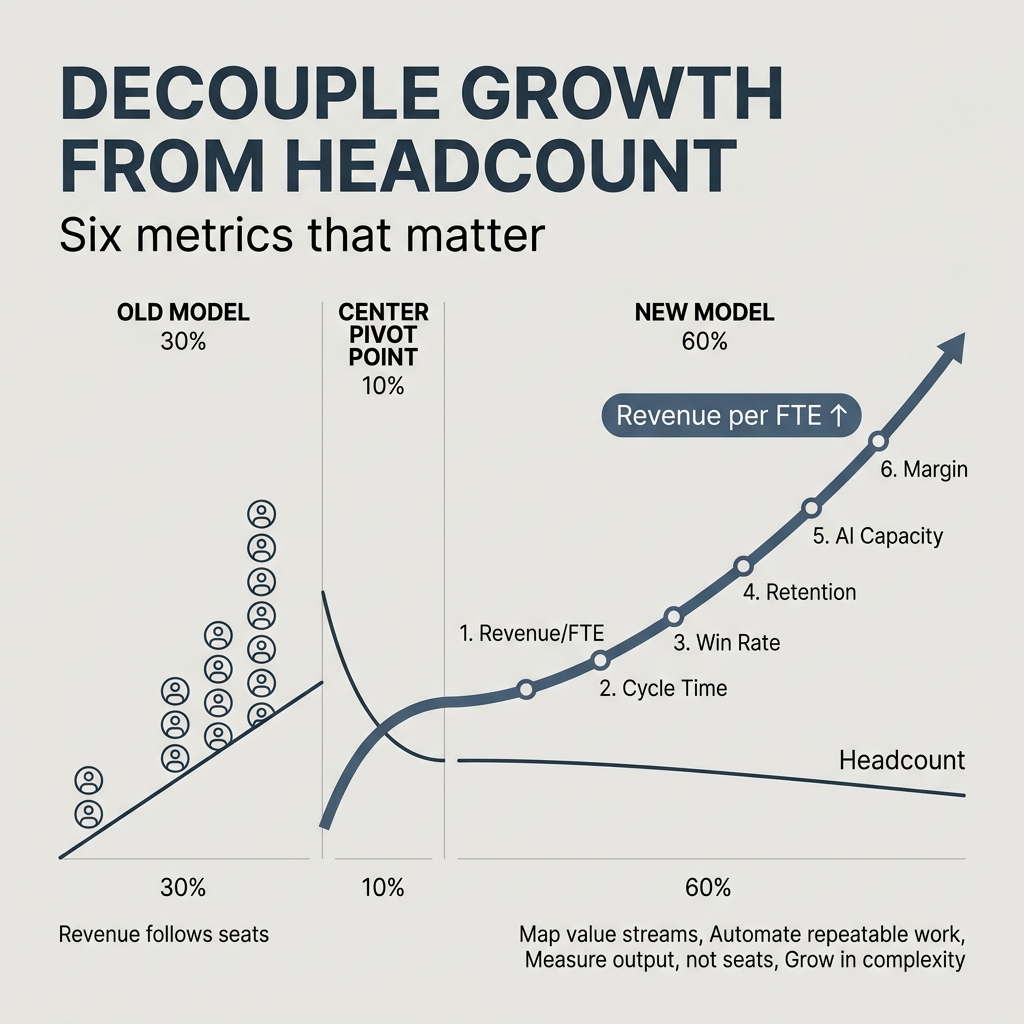
Once the value stream is mapped, I establish a small operating baseline. Six metrics tell me whether we are building a better business:
- Revenue per FTE. This exposes how much growth was purchased with labor rather than leverage. Teams usually know top-line revenue and total headcount separately. Dividing one by the other across time, products, or acquired businesses — that's the calculation that creates the first pause in the room. And it almost always does.
- Cycle time. If a fully staffed team still takes too long to produce a quote, an implementation, a product decision, or a support resolution, the issue is workflow and ownership rather than capacity.
- Win rate. It tells you whether your commercial motion converts effort into customers.
- Retention. It tells you whether customers get the value you sold them.
- Capacity freed by AI and automation. This makes leverage visible instead of anecdotal.
- Contribution margin. Revenue can look healthy while delivery and support effort quietly absorb the economics. This metric surfaces that early.
Seat count tells me we've created more seats. These six measures tell me where people spend their time and whether that time produces customer and shareholder value.
This is about seeing clearly. These metrics show you where good people are trapped in bad systems, and that knowledge protects them.
Agents Row, Humans Steer
AI changes what org design actually rewards. When agents and tools can row, I design the organization around judgment, accountability, and exception handling.
Before any hiring decision, I ask three questions in order:
- Which work is repeatable, rules-based, and safe to automate?
- Which work needs context, empathy, or commercial judgment?
- Where must a human remain the accountable owner?
That changes hiring. Fewer people doing administration, more people who can define a process, manage exceptions, interpret data, and improve the system.
It changes management too. A manager in our businesses earns recognition for outcomes: quality, cycle time, win rate, retention, capacity freed, and margin, with clear controls for risk. Team size drops out of the scorecard entirely.
Humans still steer the judgment, the relationships, and the accountability that matter. We stop hiring humans to row work a tool handles reliably.
Grow in Complexity, Not in Seats
The manager reframe is where organizational resistance lives. For many managers, team size is status. It is how they were measured, promoted, and recognized for years.
So I change the scorecard before I change the people.
The managers worth keeping can make a team more effective, develop judgment, remove friction, and own a business outcome. I set expectations in plain language: increase output and quality, shorten cycle times, improve retention or win rate, and create capacity. We review those measures consistently, and I give managers the tools and authority to improve the system.
I also separate status from span of control. A manager can lead a smaller team, a cross-functional outcome, or an automated workflow and still hold a high-value role. That's how you keep strong people in a portfolio company: meaningful accountability and a path to grow in complexity.
When a fully staffed team is slow, I make it a fact-based design conversation. I sit with the team and say: the work is important, and the current system is making it harder than it should be. Then we look together at the queue, handoffs, approvals, rework, and low-value administration.
The diagnostic question I use is this: where is the system asking good people to wait or duplicate work? That framing is generous and rigorous at the same time. It protects the people while demanding better outcomes from the process. Once the work is clearer, the team can see what success looks like and where a genuinely missing capability exists.
Reframing the Board Conversation
Everything above eventually has to survive a board meeting, and boards default to headcount plans because a hiring plan feels like management acting.
I bring a one-page operating plan instead. It follows a fixed structure:
- The outcomes we have committed to: growth, retention, delivery, and margin.
- The baseline for each.
- The constraints holding us back.
- The few interventions we believe will move the numbers.
For each proposed hire, I explain the bottleneck, the expected capacity or revenue unlocked, the time to productivity, and the metric that will tell us whether the decision worked. I also show what we will redesign or automate before we add the role.
We're allocating investment to output and capital efficiency, and we invest aggressively when the evidence supports it.
The resistance usually arrives as a request for a simple number. How many people will you add, and when. I reframe that into what the business will produce, at what contribution margin, with what cycle time and retention, and what evidence will trigger the next hire. That makes the trade-offs visible and keeps us accountable.
⚠️ If your board only sees a hiring plan with revenue projections stapled to it, they are approving inputs. Give them outcomes to approve instead.
Headcount Is an Input. Use It That Way.
If you're a CEO sitting with a board that wants a headcount plan, a team that expects to grow by adding seats, and a business that genuinely needs to scale, here's what I'd want you to take away from this.
Headcount is an input. Treat it like one.
Before you add a seat, redesign the work, measure the bottleneck, and understand what output the capital is supposed to buy. In an AI era, revenue and headcount don't have to move together anymore.
The growth question has three parts. What outcome are we trying to produce. What's the most capital-efficient way to get there. How will we know it's working.
Show your board what you'll deliver in revenue per FTE, win rate, retention, cycle time, capacity freed, and contribution margin. Your team needs to hear that agents can row and tools can remove the drudgery, and that humans steer the judgment, relationships, and accountability that actually matter.
Growth is real when output and enterprise value compound. A longer org chart only proves you bought more seats.