Culture Is the Performance System You Tolerate
Install the rhythm first. Let the behaviour accumulate. Name what you built last.

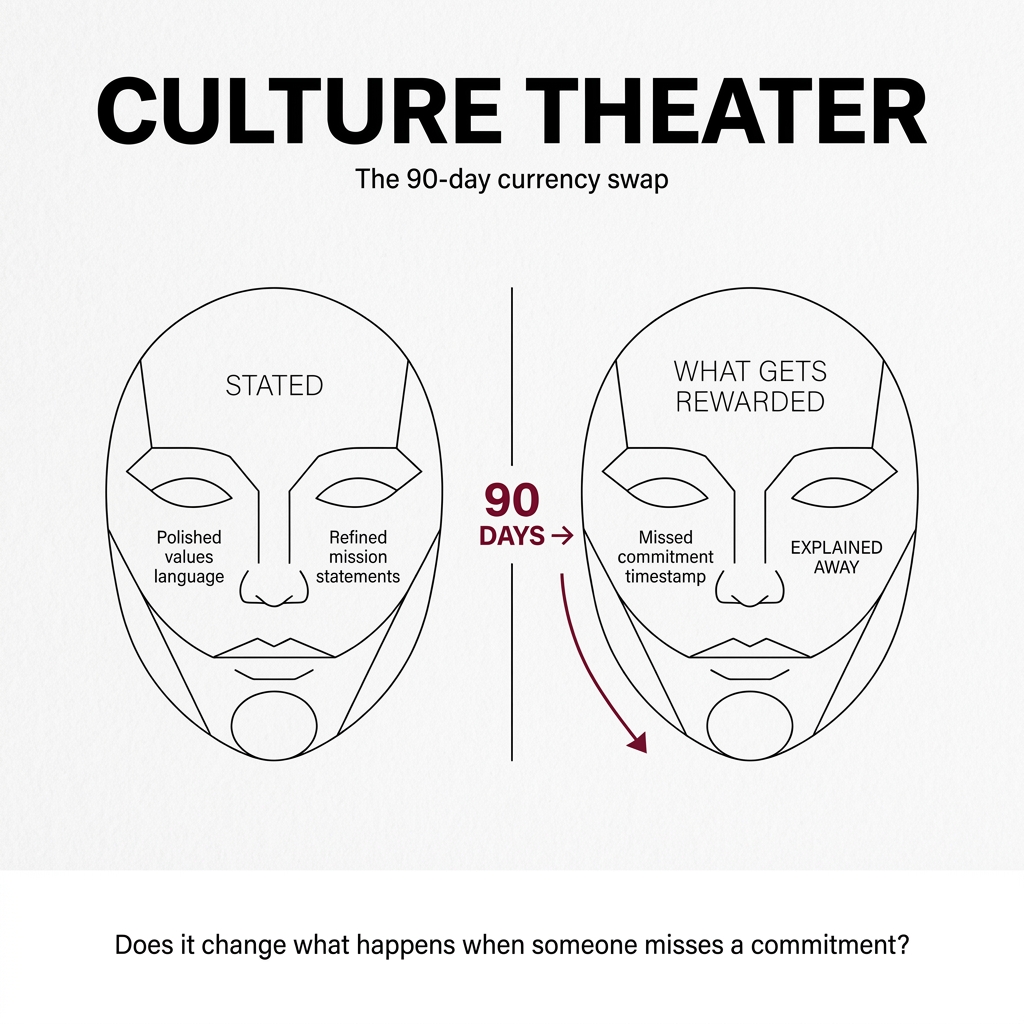
Here is the test I apply to every culture initiative: does it change what happens the next time someone misses a commitment?
If the answer is no, the initiative is theatre. Teams spend weeks refining values language while missed commitments get explained away and weak execution gets protected. The words on the wall improve. Behavior in the room stays exactly the same.
The moment a miss gets explained away looks ordinary, which is why it survives. A forecast slips in a weekly review. Instead of starting with what was promised, what happened, and why, the room jumps to context. The market was noisy. Another team was late. The person worked hard. Those facts are often real. They become a substitute for accountability.
Nobody announces a verdict. The conversation moves on, and moving on is the verdict.
The Currency Swap
The 90-day cost of that moment is larger than one missed number. It is a currency swap. The team stops trading in results and starts trading in narratives. Effort plus a plausible story becomes worth more than an accurate forecast.
Watch the room over three review cycles.
At 30 days, explanations arrive polished. People come prepared with context before anyone asks for it, because context is what got rewarded last time.
At 60 days, forecasts get softer. Committing to a precise number carries risk with no reward, so people commit to ranges, directions, and effort. Bad news travels slowly, and by the time it surfaces in a dashboard, you have lost the window to fix it.
At 90 days, the same miss recurs with a different explanation. The organization has learned to narrate variance instead of removing its cause. Meetings fill with updates and alignment while nobody makes a clear call, names an owner, or closes a loop.
Everyone in that room is rational. They learned what the system actually rewards, and they priced it in. Once that exchange rate is set, resetting it feels almost punitive even when it is simply factual.
Airtime Is the Policy
Culture signals travel through meeting behavior. The values deck tells you what the company wants to believe. The real policy is visible in one question: who gets airtime when data conflicts with the preferred story?
In the organizations I've been through, airtime follows seniority and confidence. The most senior or most familiar voice dominates. The person closest to the customer, the product, or the operational constraint gets treated as a dissenter for reporting what they see.
The senior voice never feels like it's crowding out evidence. It feels like experience. It feels like leadership. That's what makes it hard to catch.
The damage lands in decision quality, and it compounds. Every decision made without the closest voice is a small bet that the people at the top know more than they do. Those decisions look fine at the time. Six months later they look catastrophic, because the risk that got dismissed was the risk that mattered.
I want dissent early and specific. Concrete questions, not open mic: what are we not seeing, who is closest to the failure mode, what evidence would change this call. Then comes the harder part. Dissent is only real if it can change the decision. If the answer is always predetermined, asking for input becomes another ritual.
The actual test: the person who raised the risk should be able to point to a specific decision that changed because the organization listened, and that fact should be visible to everyone else in the room.
Psychological safety shows up as dissent with a track record of changing outcomes. Comfort in the room is a different thing entirely, and it gets mistaken for the real one constantly. A lot of organizations that believe they have psychological safety would fail this specific test.
One thing tells me the damage has gone deep: people privately documenting risks they no longer raise. That person still cares enough to keep a record. They've just lost faith that raising it changes anything. At that point, the organization built a listening problem, and the comfortable story that the team just isn't speaking up doesn't hold anymore.
Rhythm First, Language Last
Acquisitions make all of this faster and more visible. You inherit a business running on narrative currency and managed-upward influence. You arrive with a new performance bar. The usual mistake is almost always the same.
Leaders announce new expectations while leaving the old decision rights, meeting habits, scorecards, and tolerance for misses untouched. People hear "raise the bar" and observe that the same behaviors still earn access, promotion, and protection. They rationally keep the old norms. The integration language sounds new. The actual system doesn't move.
What breaks first is the mismatch between declared standard and operating reality, and it breaks within 30 to 60 days. The organization watches the first missed commitment under the new regime more carefully than any all-hands. The temptation in that window is real: go easier on the first miss, preserve goodwill, avoid looking like a leader who comes in swinging.
When a leader blinks in that first review cycle, the announcement becomes noise. Worse, it trains the organization to discount the next announcement too. Every word that doesn't match the behavior is a withdrawal from the credibility account you need most in exactly that window.
The sequence that works runs in the opposite order. Install the rhythm first. Behavior accumulates. Name what you built after that, not before.
What the rhythm looks like
One page. A fixed agenda. An explicit standard. A factual response to a miss:
"We said X. We delivered Y. The difference is Z. What changed? Who owns recovery? By when?"
No drama, no shaming. A miss gets a factual conversation and a recovery plan. A repeated miss gets a deeper performance decision.
💡 The operating checklist:
- Explicit standards every manager can state from memory
- An outcome scorecard, with effort tracked separately from results
- A review cadence with consequences, where the next review reflects the last miss
- Candid discussion of misses as the norm, starting with what was promised and what actually happened
- Managers coaching to the standard in every weekly conversation
Coaching to a standard respects people. It treats them as capable of meeting a bar and gives them a factual path. Protecting feelings from evidence quietly communicates the opposite. Write the values after the behavior exists, and they read as a record. Write them first, and they're just a wish.
The Five Diagnostic Questions
Leadership teams tell me the numbers are off but the culture feels fine. The team is engaged, the values are lived, people like coming to work. That calls for an audit that requires evidence, not a survey that accepts feelings and confirms the comfort.
Five questions. None of them can be answered with a feeling:
- When was the last time a commitment was missed, and what happened in the next review? This tests whether your cadence has teeth or is a recurring status meeting.
- Can every manager name the standard, describe a recent miss, and explain what changed? This tests whether the operating system reaches the people running the weekly conversations.
- What happens in the next review when the same commitment is missed again? Repeated misses reveal whether consequences exist.
- Who gets heard when data conflicts with the preferred story? Require a specific example of a decision changed by the person closest to the customer, product, or constraint. A general claim that everyone has a voice does not count.
- What is the last thing the leadership team changed its mind about because of evidence from the field? This one requires the most courage. Answering it honestly means naming something the leadership team has been complicit in. It is a diagnostic about the room.
If you sit with these five honestly and fail three, start with the manager level. That's the load-bearing wall. Every manager needs to be able to describe the standard, coach to it, and take action when it's missed. The scorecard, the cadence, the airtime given to evidence. All of it collapses if the person running the weekly conversation can't hold the standard in the room.
An organization that skips this step asks culture to do work the operating system won't do.
A lot of teams write values first and hope behavior follows. Running it the other way is harder and slower. Behavior accumulates week after week in ordinary reviews where misses get factual conversations and evidence actually changes decisions. Then you name what you built.
At that point the words on the wall describe something real.